Home / Fire & Rescue

Firefighting & Emergency Response Robot Dog

First in, so crews are not. Thermal reconnaissance, 3D structure mapping and atmosphere checks — delivered before a single firefighter enters.

Thermal reconnaissance 3D structure mapping Gas & atmosphere checks Two-way comms
Why departments buy this

Every recon entry spends a crew before you know what is inside

Information vacuum

Fireground decisions hinge on conditions inside the structure — heat profile, layout, hazards, victims. That information currently costs a crew entry to obtain.

Unknowable atmospheres

Hazardous gases, oxygen deficiency and structural collapse risk cannot be assessed from the curb. The robot measures them before anyone crosses the threshold.

Time is the real enemy

Recon performed in parallel with staging compresses the decision loop — the robot goes in while crews gear up, and command gets a picture in minutes, not after first entry.

What the robot delivers on scene

  • Thermal reconnaissance — the fireground picture from inside: hot spots, seat of fire, structural heat load, overlaid live for command.
  • 3D structure mapping — LiDAR builds a floor plan and stair profile in minutes, giving crews an entry plan instead of a guess.
  • Atmosphere monitoring — oxygen, combustible gas and toxic gas readings with location tags; alarms on dangerous thresholds.
  • Two-way audio & video — command sees and speaks through the robot, including to anyone found inside.
  • Stairs, rubble and confined spaces — legged mobility goes where wheeled platforms cannot: stairs, debris, narrow corridors.
  • Rapid deployment — carried by one responder, operational in under two minutes, tether-optional for extended missions.
Recon configuration
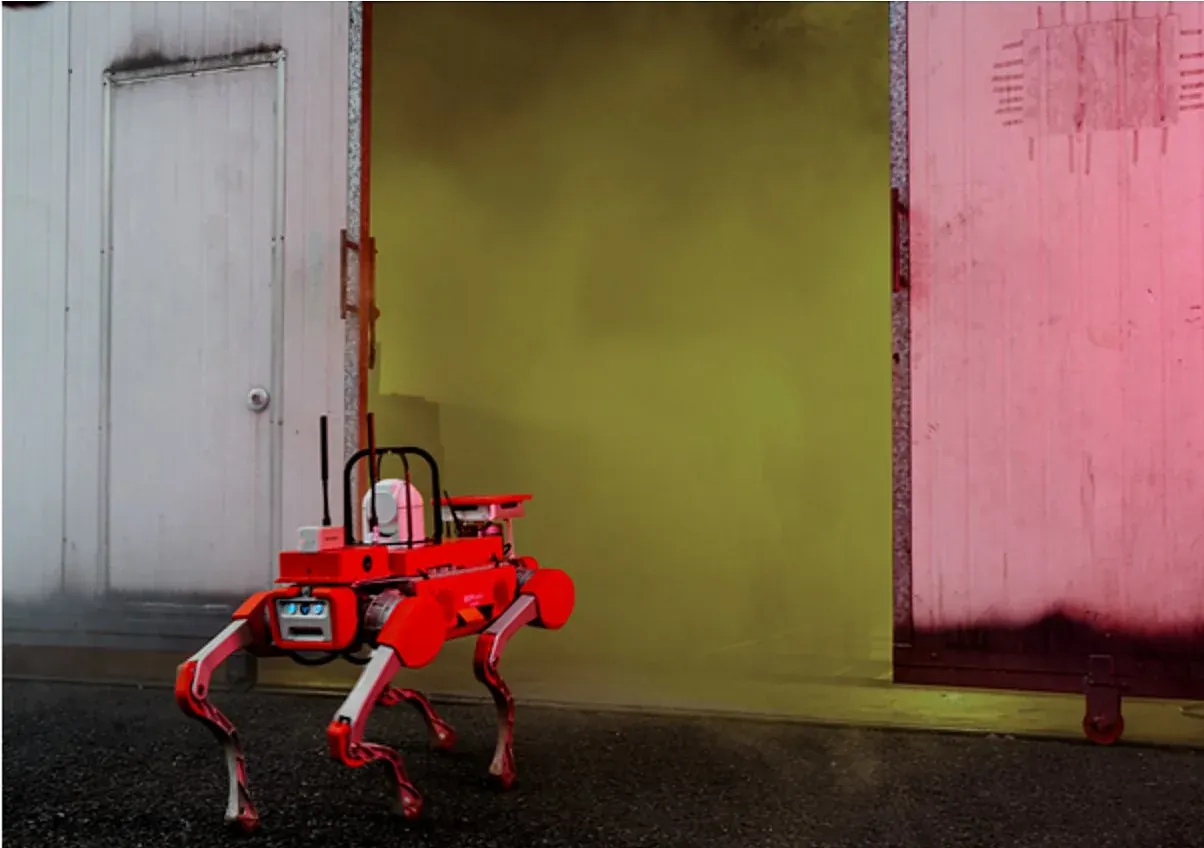
Placeholder — replace with field imagery
Typical configuration

Reference specification — adapted to your department

Thermal cameraRadiometric with high-temperature range for fireground use; hot-spot overlay in command view
MappingLiDAR SLAM; 3D floor-plan output in minutes; stair and level detection
Gas / atmosphereO₂, LEL, CO and optional H₂S channels with location-tagged alarms
CommunicationTwo-way audio + video; range-extendable with mesh nodes; optional tether
MobilityStair climbing, rubble traversal, step-over; confined-corridor profile
DeploymentCarry-case transport; operational in <2 minutes
EnvironmentalIP67 typical; heat-shielded sensor housing for approach operations
SoftwareCommand dashboard on tablet / vehicle screen; mission recording and playback
Operational note: This system supports reconnaissance and decision-making; it is not a structural fire suppression device. Deployment protocols, including approach limits, are defined with your department’s command procedures.
Getting operational

Adoption path for departments

Mission review

We map your response scenarios, apparatus fit and command workflow to configure the system and training.

System delivery & training

Unit delivered with operator and command-staff training, including live-fire-adjacent drills on your training ground.

Drill integration

Standard operating procedure drafting and joint drills until recon deployment is a reflex, not a novelty.

<2
min to operational on scene
1
responder carries & operates it
3D
structure map in minutes
0
crew entries needed for recon

Talk to us about a department pilot or demo

Tell us your response scenarios and apparatus. We can arrange a demonstration or a pilot program and respond within one business day.

✉ sales@qinqirobotics.com  ·  Response within 24h