Home / Oil & Gas Inspection

Explosion-Proof Robot Dog for Oil & Gas Inspection

A quadruped robot that walks refinery rounds in classified areas — carrying gas detectors, thermal imaging and two-way audio — so your technicians stop walking through them.

ATEX / IECEx Zone 1 Gas detection (LEL, O₂, H₂S) Thermal imaging Autonomous patrols
Why operators buy this

The three costs of manual rounds in classified areas

HSE exposure

Every manual round in a Zone 1 or Zone 2 area carries ignition, gas-exposure and fall risk. One incident is a reportable event; a serious one can shut a site down.

Late detection

Gauges read on a schedule miss what happens between rounds — a slow leak, a hot bearing, a valve that starts weeping at 2 a.m. Detection is only as good as the round frequency.

Manpower squeeze

Refineries run 24/7. Three shifts of trained technicians for routine rounds is expensive, hard to staff, and exactly the work automation removes fastest.

A robot built around your site’s hazard classification

  • ATEX / IECEx configurations for Zone 1 and Zone 2 duty — the robot is specified against your site’s area classification, not offered as a blanket “safe” claim.
  • Multi-gas detection — LEL (combustible), O₂, H₂S and optional CO / NO₂ channels, with live telemetry and alarm geolocation on your map view.
  • Dual-spectrum thermal + visible imaging — catches hot spots on flanges, heat exchangers and electrical cabinets before they become failures.
  • Autonomous scheduled rounds — cover the same route your technician walks, on a schedule you set, in rain, heat and dust, with auto-dock charging.
  • Two-way audio & video — remote operators see and speak through the robot, turning a round into a live attended inspection when needed.
  • GPS-denied SLAM navigation — works under pipe racks, inside compressor buildings and in steel-dense process areas where GNSS is unavailable.
Confined-space & hazardous-area patrols
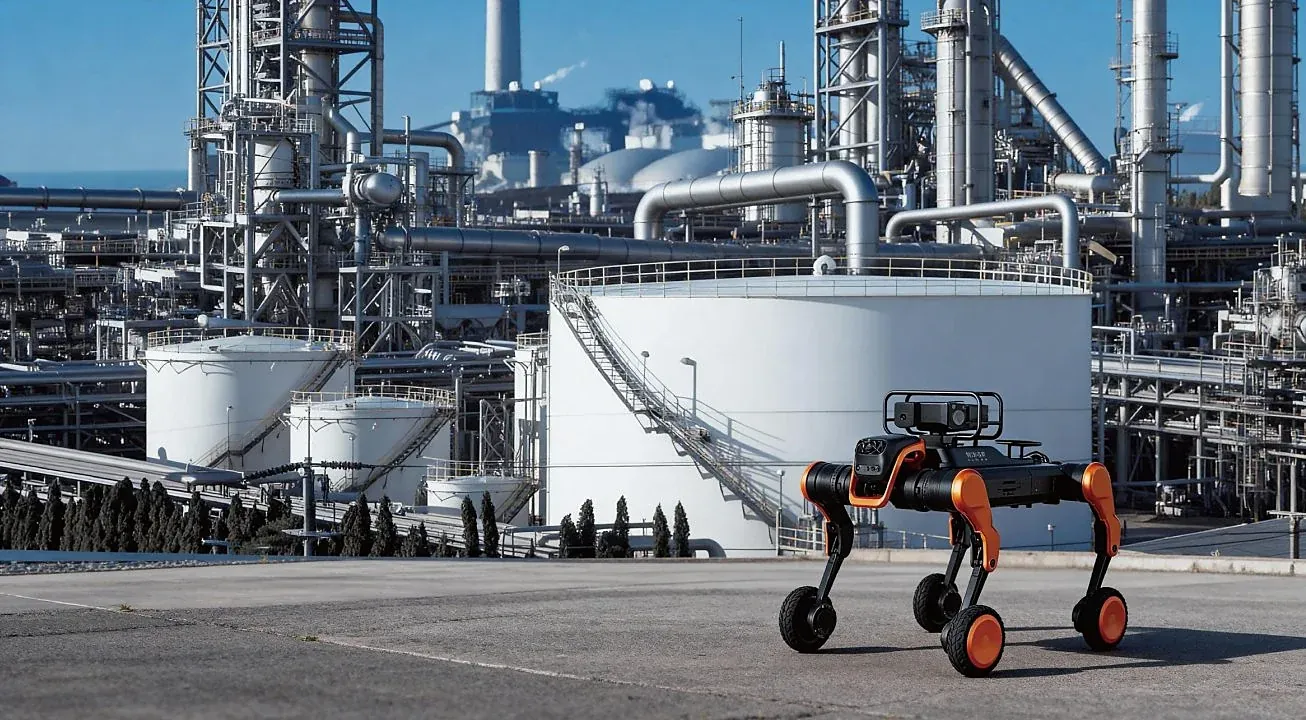
Wheeled-leg inspection robot patrolling a refinery tank farm and process units
Wheeled-leg robot patrolling tank farms and process units in a petrochemical complex
Typical configuration

Reference specification — adapted to your site

Specifications below are typical for an oil & gas inspection system. Final values depend on platform selection, hazard classification and payload mix.

Hazard-area complianceATEX / IECEx configurations available for Zone 1 and Zone 2 duty (certification scope confirmed per site and per configuration)
Gas detectionLEL (catalytic), O₂, H₂S standard; CO, NO₂, CH₄ channels optional
ImagingVisible 4K + radiometric thermal (e.g. 640×512); dual-spectrum fusion view
Navigation3D LiDAR SLAM, GPS-denied capable; route editor with waypoint-based patrols
Runtime / chargingPlatform-dependent; auto-dock charging station; optional long-endurance packs matched to your route length
Ingress protectionIP67 typical (config-dependent)
Payload capacityUp to 15 kg for sensors, speakers, lights and comms
Software interfaceROS 2 + Python SDK, REST API, dashboard with live map, alarms and report export
IntegrationOutputs compatible with your CMMS / historian; alarm webhooks to your systems
Certification note: Explosion-proof certification is configuration- and jurisdiction-specific. We engineer the system to your site’s area classification and support certification with the relevant notified body for your region — this is scoped in the feasibility assessment, not glossed over.
Deployment blueprint

How an oil & gas deployment typically looks

A reference shape for a quadruped inspection rollout in oil & gas. Every system is re-scoped to your site — this is the typical starting point, not a fixed offer.

Typical environments

  • Refinery process units & pipe racks
  • Tank farms & storage terminals
  • LNG & gas-processing plants
  • Compressor & pumping stations
  • Pipeline right-of-way & offshore platforms

Key constraints

  • ATEX / IECEx Zone 1–2 classification
  • Flammable gas & vapour presence
  • Confined-space entry risk
  • GNSS-denied under pipe racks & structures
  • Heat, corrosion & washdown exposure

Platform, payload & routine

  • Ex-proof platform matched to zone (e.g. Micbot MOVENEW P1/P2)
  • Payload: multi-gas (LEL/O₂/H₂S, optional CO/CH₄) + radiometric thermal + acoustic leak
  • Autonomous scheduled rounds past flanges & valves
  • Daily perimeter + night rounds, auto-dock charging
  • Wheeled-leg configuration — on long, straight, flat routes across process units and tank farms, a wheeled-leg platform travels farther per charge while still clearing kerbs, drains and pipe crossings; switch to a pure-legged platform for steep or cluttered sites.
What you can expect: Earlier detection of leaks and hot spots between manual rounds; fewer hazardous-area and confined-space entries for technicians; continuous night coverage without shift premium.
Platform selection

Quadruped or wheeled? We pick for your terrain

As your integration partner we assess the actual route, not a catalogue. Morphology is a means to coverage, not a dogma — here is the honest trade-off we apply on every survey.

Where a quadruped wins

  • Stairs, ladders and elevation changes
  • Steel grating, cable trays, kerbs and debris
  • Unpaved, muddy or uneven ground
  • Mixed indoor–outdoor and rough terrain

Where a wheeled AMR wins

  • Long, flat, obstacle-free process roads
  • Paved tank-farm perimeters and hardstands
  • Smooth indoor corridors with few thresholds
  • High-speed, high-frequency long-distance runs

How we decide

  • Walk your real route during the site survey
  • Score by terrain mix, distance and payload
  • Recommend the morphology that fits
  • Tell you if a segment needs a different platform
In a petrochemical complex: flat, non-classified areas — tank-farm perimeters, paved hardstands, long access roads — are where a wheeled AMR covers distance efficiently. Classified units, skids with stairs and cable trays still favor a quadruped. We scope the two together rather than forcing one morphology, and confirm area classification before any platform is specified.
From assessment to running rounds

Deployment in four steps, ROI math included

Site assessment

Routes, hazard zones, standards, data outputs and comms coverage mapped — on-site or remote.

System configuration

Platform, payloads and certification path agreed; system built and tested against your environment.

Commissioning

Deployed and validated on site, with your operators trained on the console and dashboards.

4–8
weeks to deployment (typical)
12–18
months typical payback on rounds coverage
~50%
lower TCO vs. big-brand systems
24/7
round capability, no shift premium
Related insights

Read next

FAQ

Questions engineers ask before a pilot

Can the robot work inside classified (ATEX / IECEx) areas?

We build each system to the zone classification you specify, and select a platform rated for that duty — for example the Micbot MOVENEW P1/P2 explosion-proof and anti-magnetic variants, which suit Zone 1/2 petrochemical duty. Final certification is issued by the notified body for your site, so we deliver the technical file, hazard assessment and documentation package your certifier needs rather than claiming a blanket certificate.

Can it actually detect gas leaks while it walks?

Yes. Typical payloads include a methane/LEL sensor, a thermal camera for invisible vapour plumes, and an acoustic sensor for pressurised leaks. The robot follows a defined route past flanges, valve glands, seals and pump seals, and flags readings above threshold. It complements your fixed gas detection system — it does not replace it, and it reaches the points fixed heads cannot cover.

How does it handle gratings, kerbs, gravel and stairs?

Industrial quadrupeds are built for exactly this: steel grating, unpaved ground, cable trays, kerbs up to roughly 20–25 cm and standard industrial stairs are all within normal capability. We confirm it on your own route during the site survey rather than on a spec sheet — if a segment is genuinely beyond the platform, we tell you before you commit.

Who owns the inspection data, and where does it go?

You do. Readings, images and reports can stay entirely on your own servers. We integrate with your historian, SCADA or CMMS through a standard API or scheduled export in common formats, and there is no mandatory cloud dependency. If your policy requires an air-gapped deployment, we scope it that way from the start.

Discuss your site’s hazard classification and inspection routes

Tell us the plant type, area classification and the rounds you want automated. We’ll respond within one business day with a feasibility assessment and indicative pricing.

✉ sales@qinqirobotics.com  ·  Response within 24h