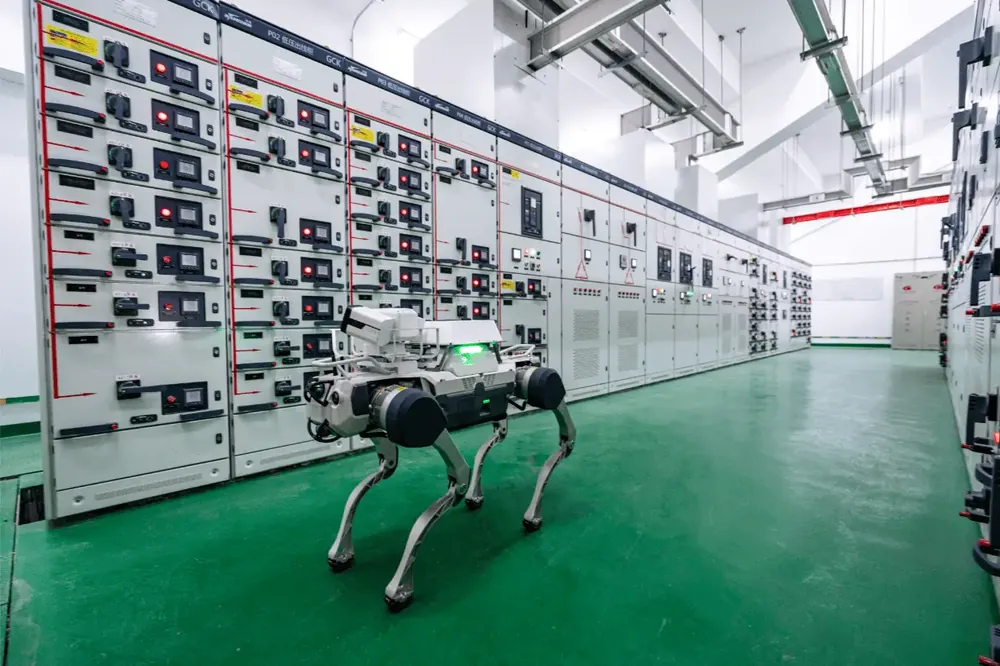
Dose-aware walkdowns of controlled areas, pump rooms and cable spreads — radiation mapped, thermal anomalies caught and every observation recorded to audit standard, without sending an operator into the field.
Routine surveillance entries, even in low-dose-rate areas, accumulate across the year. Robots take the repeat readings so people are reserved for tasks that genuinely need them.
Regulatory walkdowns demand traceable evidence. Photos, readings and locations captured automatically are consistent and timestamped — not dependent on an operator’s camera discipline.
Cable spreads, valve galleries and pump halls mix steps, grating and cluttered floors. Legged platforms go where rails and drones cannot, without permanent install work in radiological areas.
| Radiation sensing | Gamma dose-rate detector sized with your RP team to the expected range; continuous logging with alarm thresholds |
|---|---|
| Thermal camera | Radiometric module for plant and electrical targets |
| Visible camera | 4K with zoom and low-light capability for indoor plant areas |
| Navigation | 3D LiDAR SLAM, fully GPS-denied; reliable in plant halls and cable spreads |
| Records | Structured round reports: readings, geolocated imagery, dose map; export formats agreed with your document control |
| Environmental | Dust-protected build; decontamination-wipeable surfaces; operational limits set per your area classification |
| Software | ROS 2 + Python SDK; dashboard with dose heat-map, round history and export tooling |
| Security | On-site data handling; no cloud dependency required; integration into your plant networks per your cyber rules |
A reference shape for a quadruped inspection rollout in nuclear facilities. Every system is re-scoped to your site — this is the typical starting point, not a fixed offer.
Walkdown routes, dose zones, RP requirements and record formats agreed with your operations and RP teams.
Detector range, reporting formats and navigation behaviour configured for the selected areas.
Supervised rounds, RP sign-off of procedures, operators trained, records flowing to document control.
The robot is the smallest line item. A real total-cost-of-ownership model for industrial inspection quadrupeds — and the hidden costs that blow the budget.
Read article →A vague spec gets vague bids you cannot compare. The eight sections every bid-able inspection-robot specification needs — and the acceptance test that protects you.
Read article →It varies by platform and by component, and we state the real figure in the specification rather than a range that flatters it. Electronics have a cumulative dose limit, so we plan routes and round frequencies against the measured dose field of your areas. In practice the system is used to take the dose off people in the areas that consume your budget, with the platform treated as a managed component with a tracked dose history.
Yes — decontamination is a design input, not an afterthought. The platforms we configure use smooth, washable surfaces, sealed joints and minimal crevices, and they tolerate standard decon agents used at your facility. Where required, we specify a bagging or shrouding approach. Decon procedure is agreed with your health physics team during commissioning.
In most regimes the answer is that it replaces the person's exposure, not the qualified inspector's judgement — the record still carries a responsible reviewer. We deliver traceable, timestamped, position-tagged evidence that supports that review, and we provide the documentation your quality organisation needs to qualify the method. We do not overstate what automation can settle for you.
Typically yes: standard industrial stairs, gratings, cable trays, airlock thresholds and confined access are within quadruped capability. The constraints are usually door widths, hatch dimensions and clearance at specific penetrations. We walk the actual route with you — or against your drawings — and confirm reachability before you commit to a pilot.
Share the target areas, current entry frequency and record requirements under NDA if needed. We’ll come back with a route plan, detector configuration and indicative pricing within one business day.